
BTS’s 2026–2027 Global Concert Tour: Projected Revenue, Tourism Spillovers, and Economic Influence
Author(s): Associate Professor Edward Tay.
Organization: Asian Institute of Digital Finance, National University of Singapore.
Date: 20th March 2026
1. Executive summary
BTS’s 2026 return is not just a music event. It is a multi-layer economic catalyst for Korea’s visitor economy, consumer spending, media exports, and global brand equity. The Seoul comeback concert at Gwanghwamun Square is expected to draw up to 260,000 spectators around the venue, including 22,000 ticket holders, while being livestreamed by Netflix to 190 countries.
The core thesis of this paper is simple: BTS’s Greater Seoul kick-off concert should be analysed not only as ticket revenue, but as a stack of economic layers including tourism, hotels, restaurants, local transport, merchandise, pop-up retail, earned media, destination marketing, and long-tail global attention. Drawing on market prices from Taylor Swift’s Eras Tour and BLACKPINK’s recent touring cycle. Taylor Swift’s final official Eras Tour tally reached US$2.0776 billion in ticket sales from 10,168,008 attendees across 149 shows, while BLACKPINK’s completed Born Pink tour drew 1.8 million fans and grossed roughly US$330 million.
My base-case conclusion is that the Greater Seoul kick-off concert (Seoul comeback event + Goyang paid opener) can conservatively generate about ₩70.2 billion in direct spending, or roughly US$47.7 million at a ₩1,470/US$ exchange rate.
The broader global tour could generate ₩2.7 trillion in revenue, placing it in the same commercial class as the largest tours in history.
Disclaimer: These are author’s projections, not official BTS disclosures, and they are built from the public benchmarks and assumptions explained below.
2. What is officially confirmed
2.1 Seoul comeback event
BTS’s official comeback event, “BTS The Comeback Live: Arirang,” is being staged at Gwanghwamun Square in Seoul and streamed worldwide on Netflix. Reuters reported that the event is Netflix’s first global broadcast of a music concert, that it will stream to 190 countries, and that the crowd around the square could reach 260,000, including 22,000 ticket holders.
2.2 Paid tour opener in Greater Seoul
The official paid kick-off concert to the world tour is “BTS WORLD TOUR ‘ARIRANG’ IN GOYANG” at Goyang Sports Complex Main Stadium on April 9, 11, and 12, 2026. Official ticket prices listed on the NOL page are ₩264,000 for Soundcheck, ₩220,000 for General R, and ₩198,000 for General S. The official venue description also confirms a 360-degree stage, which is important because it usually improves sellable seating inventory versus a single-front stage.
2.3 Official BTS demand and digital scale
BTS’s digital scale is already large enough to amplify the economic spillover far beyond the venue. As of March 2026, BANGTANTV showed about 82.6 million YouTube subscribers, BTS official Instagram was tracked at about 78.2 million followers, and BTS’s official TikTok account showed about 73.9 million followers. That is a combined non-deduplicated footprint of roughly 234.7 million followers/subscribers across three major platforms alone.
3. Why BTS’s Seoul launch is economically different
BTS’s kick-off concert should be treated as a hybrid music-tourism-media event rather than only a concert. Seoul gains a one-hour global livestream from a highly symbolic civic space, while Goyang gains three monetised stadium dates with premium ticketing. In practice, this means Korea gets both a global broadcast showcase and a ticketed consumer-spending event, which is a better economic structure than a standard arena stop. Reuters also reported that analysts see the 2026–2027 BTS tour as the largest K-pop band world tour yet, spanning 34 cities and 82 concerts, with one Seoul-based analyst forecasting roughly ₩2.7 trillion in tour revenue.
4. Benchmarking BTS against Taylor Swift and BLACKPINK
4.1 Taylor Swift benchmark: the global “event economy” model
Taylor Swift’s Eras Tour is the clearest modern benchmark for understanding concert spillovers into tourism and urban spending. Official numbers released after the final show put the tour at US$2,077,618,725 in ticket sales, 10,168,008 attendees, and 149 sold-out shows, with an average ticket price of about US$204.
The local spillovers were equally important. The U.S. Travel Association said Swifties averaged roughly US$1,300 in local spending on travel, hotels, food, merchandise, and costumes, and estimated US$5 billion+ in direct spending from the first U.S. leg, while saying the total economic effect likely exceeded US$10 billion. In Los Angeles, a California jobs report estimated US$320 million in GDP impact, 3,300 jobs, and US$160 million in local earnings from Swift’s six SoFi Stadium nights; in Colorado, a separate study estimated US$140 million in GDP impact from the Denver shows.
What this means for BTS
For BTS, the Taylor lesson is not that BTS must match Taylor show-for-show; it is that mega-fandom behaves like mobile tourism demand. When emotional demand is high, the spending basket expands from “ticket” to “trip.” That is why BTS’s Seoul/Goyang launch should be modelled as a destination event rather than a simple entertainment purchase.
4.2 BLACKPINK benchmark: the K-pop stadium-tour model
BLACKPINK is the more relevant K-pop peer benchmark. BLACKPINK’s completed Born Pink World Tour ran 66 shows, drew 1.8 million fans, and grossed about US$330 million, making it the highest-grossing tour by a female group and, at the time, by an Asian act. Billboard’s reported 2023 subset alone showed US$148.3 million from 29 reported shows and 703,000 attendees.
For the current cycle, BLACKPINK’s Deadline tour began at Goyang Stadium in July 2025 and drew 78,000 fans across two nights. The official BLACKPINK tour site later listed the tour as a sold-out, stadium-heavy run across North America, Europe, and Asia. At the city level, BLACKPINK’s Kaohsiung stop reportedly drew 120,000 attendees, generated about NT$300 million (US$9.8 million) in tourism revenue, lifted metro ridership sharply, and increased some night-market sales by 30% or more.
What this means for BTS
The BLACKPINK evidence is important because it shows that K-pop stadium events in Asia already generate measurable local tourism gains, even before one layer on the extra weight of BTS’s larger digital footprint and broader male-group global demand.
BTS should therefore reasonably be expected to perform above BLACKPINK on media reach and potentially above on tourism pull, especially for a comeback cycle after a multi-year full-group hiatus.
5. Macro assumptions for 2026–2027: inflation, interest rates, and FX
The macro environment matters as war-driven inflation will change concert economics.
The Bank of Korea left the base rate at 2.50% in February 2026 and lifted its 2026 inflation forecast to 2.2%. KDI projected 2026 CPI at around 2.1%, while the OECD said headline inflation should remain around the 2% target in 2026 and 2027, while also assuming the policy rate could fall to 2.25% by mid-2026.
However, the 2026 Iran–U.S.–Israel war materially worsens the inflation and FX picture.
Reuters market coverage on 20th March 2026 said Brent crude was still around US$105.43 a barrel even after easing. Reuters also reported that the Korean won briefly breached ₩1,500 per US$, hitting ₩1,505.8, before pulling back, while a professor survey in Korea suggested a 2026 range of roughly ₩1,403 to ₩1,516.
South Korea has also publicly acknowledged that it imports almost all of its energy, with Reuters saying about 70% of its oil and 20% of its LNG come from the Middle East.
My base-case paper assumptions are:
Korea CPI inflation: 2.4% in 2026, easing to 2.2% in 2027. This is modestly above the BOK/KDI baseline because of the oil-war premium.
BOK policy rate: 2.50% average in 2026, then 2.25% in 2027. This follows the actual 2.5% base rate and the OECD easing path assumption.
KRW/USD exchange rate: ₩1,470/US$ in 2026 and ₩1,430/US$ in 2027 in the base case, reflecting current war-driven weakness but some later normalisation. This sits inside the ranges implied by current market stress and economist surveys.
6. My projected revenue model for the Greater Seoul kick-off
Important note
The figures below are not official BTS/HYBE disclosures. They are author’s projections built from:
Official BTS ticket prices and event sizes,
Seoul crowd estimates,
Taylor Swift and BLACKPINK spending benchmarks, and
Current Korean economy macro assumptions.
6.1 Base-case direct spending estimate (Greater Seoul kick-off concert)
A. Goyang paid concerts (3 shows)
Base paid attendance assumption: 105,000 across three nights (roughly 35,000 per show, consistent with a stadium concert build). This is a modelling assumption anchored to Goyang’s large-stadium format and the official sold-out launch concert.
Average blended ticket price assumption: ₩220,000 per attendee, based on official ticket tiers of ₩198,000 / ₩220,000 / ₩264,000.
Projected ticket revenue: ₩23.1 billion (US$15.7 million at ₩1,470/US$). (Author’s model based on official ticket prices.)
B. Official merchandise and souvenirs
Base merchandise/souvenir spend assumption: ₩60,000 per paid attendee. This is conservative when set between BLACKPINK’s Kaohsiung tourism-per-attendee benchmark and Taylor’s much higher all-in fan spending benchmark.
Projected merchandise/souvenir revenue: ₩6.3 billion (US$4.3 million). (Author’s model.)
C. Tourism, hotels, food, local transport, shopping
Base traveller mix assumption: 35% out-of-town/inbound, 65% local/regional day-trippers. BTS’s comeback status and international ARMY base make a higher traveller share plausible than an ordinary domestic show.
Base traveller non-ticket spend assumption: ₩650,000 per traveller, covering hotel nights, food, local transport, and shopping. (Author’s model, calibrated below Taylor’s U.S. average spend but materially above ordinary domestic-event norms.)
Base local attendee non-ticket spend assumption: ₩120,000 per local attendee on transport, F&B, convenience retail, and incidental shopping. (Author’s model.)
Projected tourism/local-spend total: ₩32.1 billion (US$21.8 million). (Author’s model.)
D. Seoul comeback-night spending
Reuters said the Seoul event could draw 260,000 people around Gwanghwamun, including 22,000 ticket holders. For the base case, we assume a portion of those non-ticket spectators still spend on transport, convenience stores, cafés, meals, and nearby retail.
Base projected Seoul-event spending: ₩8.7 billion (US$5.9 million). (Author’s model.)
E. Base-case total
Projected direct Greater Seoul kick-off concert spending: ₩70.18 billion, or about US$47.74 million. (Author’s model.)
6.2 Scenario range
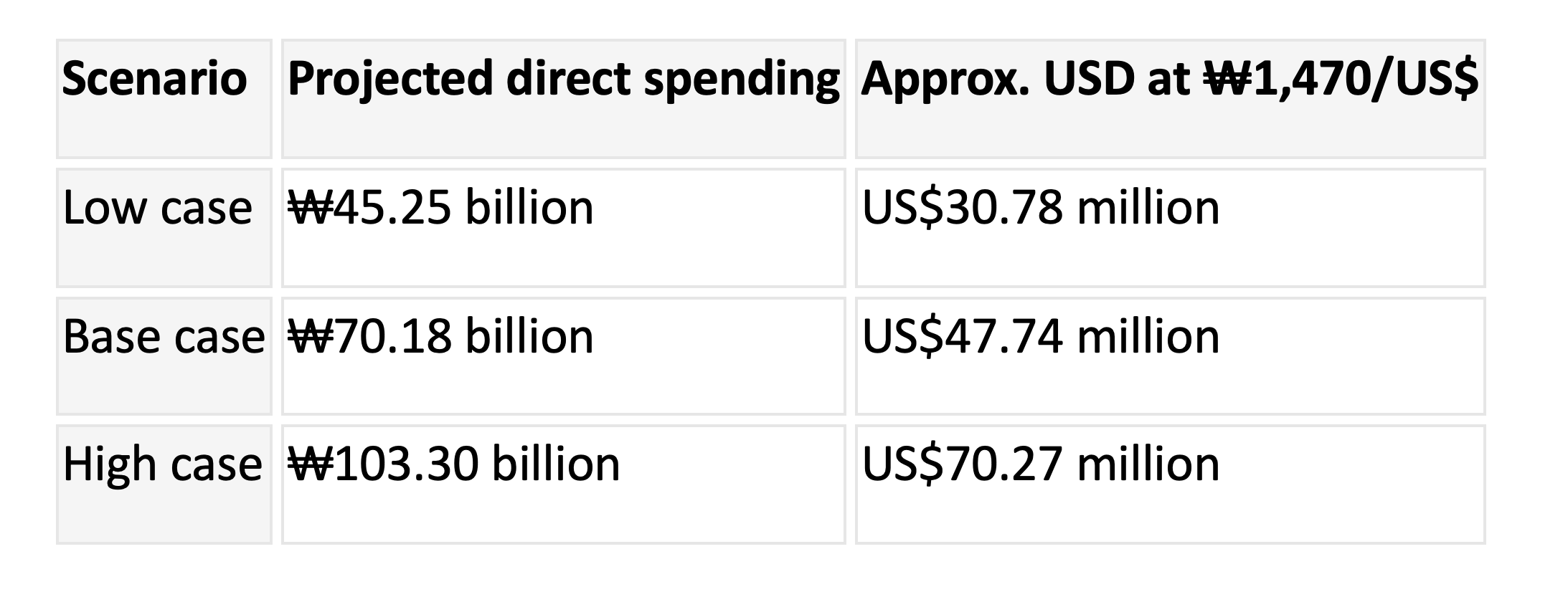
These scenario totals are author’s calculations built from the official price points, official event scale, and benchmark spending behaviour seen in Taylor Swift and BLACKPINK case studies.
7. Projected global BTS tour revenue
Reuters reported that BTS’s 2026–2027 ARIRANG tour is expected to run through 34 cities and 82 concerts, and cited an analyst forecast of about ₩2.7 trillion in revenue. At a ₩1,470/US$ exchange rate, that is about US$1.84 billion.
That would place BTS firmly in the top tier of all-time global tours, though still below Taylor Swift’s official US$2.0776 billion final ticket-sales figure.
My working split of the ₩2.7 trillion publicized tour figure
Again, this split is modelled, because the public record gives the headline number, not the exact composition:
Ticketing: ₩2.05–2.16 trillion (about 76–80% of total) (author’s model)
Merchandise / official goods / venue retail: ₩270–405 billion (about 10–15%) (author’s model)
Sponsorship / streaming / licensing / activation: ₩190–325 billion (about 7–12%) (author’s model)
This split is consistent with how modern super tours monetise beyond the seat alone, especially when the artist has BTS’s digital footprint and cross-platform media appeal.
Taylor’s tour demonstrated how the value chain extends well beyond the venue, and BLACKPINK’s touring cycle shows that K-pop’s own stadium economics are already mature.
8. Where the Korean economy benefits most
To understand BTS’s economic influence is to think in five pillars:
Tickets: money paid directly for entry into the Goyang opener.
Tourism: hotels, serviced apartments, food, cafés, shopping, and attractions used by ARMY coming from outside Seoul/Gyeonggi or from overseas. Taylor and BLACKPINK both proved this category can be very large.
Transport: airport transfers, KTX/subway/bus rides, taxis, ride-hailing, and intercity movement. Seoul City’s large-scale transport planning for the Gwanghwamun event shows this is not trivial.
Merchandise and fan spending: light sticks, apparel, posters, convenience purchases, and themed pop-up spending.
Media and advertising value: the Seoul livestream to 190 countries effectively acts like a giant destination advertisement for Korea, even if the cash effect is not visible on the same day.
9. Final conclusion
My bottom line is that BTS’s 2026 Greater Seoul kick-off concert is likely to be one of Korea’s most economically meaningful cultural events of the decade.
The combination of a globally streamed Seoul comeback spectacle, a sold-out premium-priced Goyang tour opener, and BTS’s unusually large digital reach gives it a stronger economic profile than a normal concert series.
In my base case projection, the kick-off concert can generate around ₩70.2 billion (US$47.7 million) in direct spending; in a stronger upside case, it can exceed ₩100 billion (US$70 million).
Meanwhile, the publicized global-tour revenue figure of roughly ₩2.7 trillion suggests BTS will sit in the same commercial league as the biggest touring acts in history.
An important adjustment for 2026–2027 is macro risk: war-related oil inflation, a weaker won, and higher imported energy costs can squeeze margins for promoters, vendors, and consumers.
Yet history from Taylor Swift and BLACKPINK suggests that truly top-tier fandom demand is often surprisingly resilient, even in higher-cost environments.
